

The Three-Minute Pilot
What social sitcoms can teach every writer about character, constraint, and killing your darlings
Announcements!
The Convergence Report
In case you haven’t already, be sure to check out my other publication:
In it, I discuss the convergence economy, which is my name for the emerging business layer in the space where traditional media and the creator economy meet. It’s based on a custom news aggregator (yes it’s built using AI, no I don’t feel guilty about that fact) that surfaces stories (and jobs) from that space on a weekly(ish) basis.
ATX TV Festival
Anyone attending the Austin TV Festival this year? I sure am! Because of this newsletter, I was granted a media badge to attend. Please ping me if you want to connect!
On to it!
The Menace of Exposition: A Substack Writer’s Dark Descent into Madness
Three weeks ago, this post started as an indictment against the menace of exposition.
I started writing about the compulsion many writers have to over-explain characters’ backstories, to baldly state how they feel about XYZ thing...
There’s a sort of sinister logic at work here: Writers spend a bunch of time developing characters, writing elaborate backstories and family history and trauma and personal preferences and cultural rituals – as they should.
But then, after doing all this work, the writer feels compelled to outlay all of this stuff in the first episode of a series or the first act of a feature.
I understand the impulse: The world deserves to know how much effort you put into these characters… But the thing is this: Backstory ≠ story, and this isn’t middle school algebra. You don’t need to “show your work” in order to prove your brilliance.
As you can tell, I have very big feelings on the matter and soon, my post spiraled into an all-out shouting match between me and some invisible writer straw-man who practices all the bad habits I try to steer people away from in this newsletter.
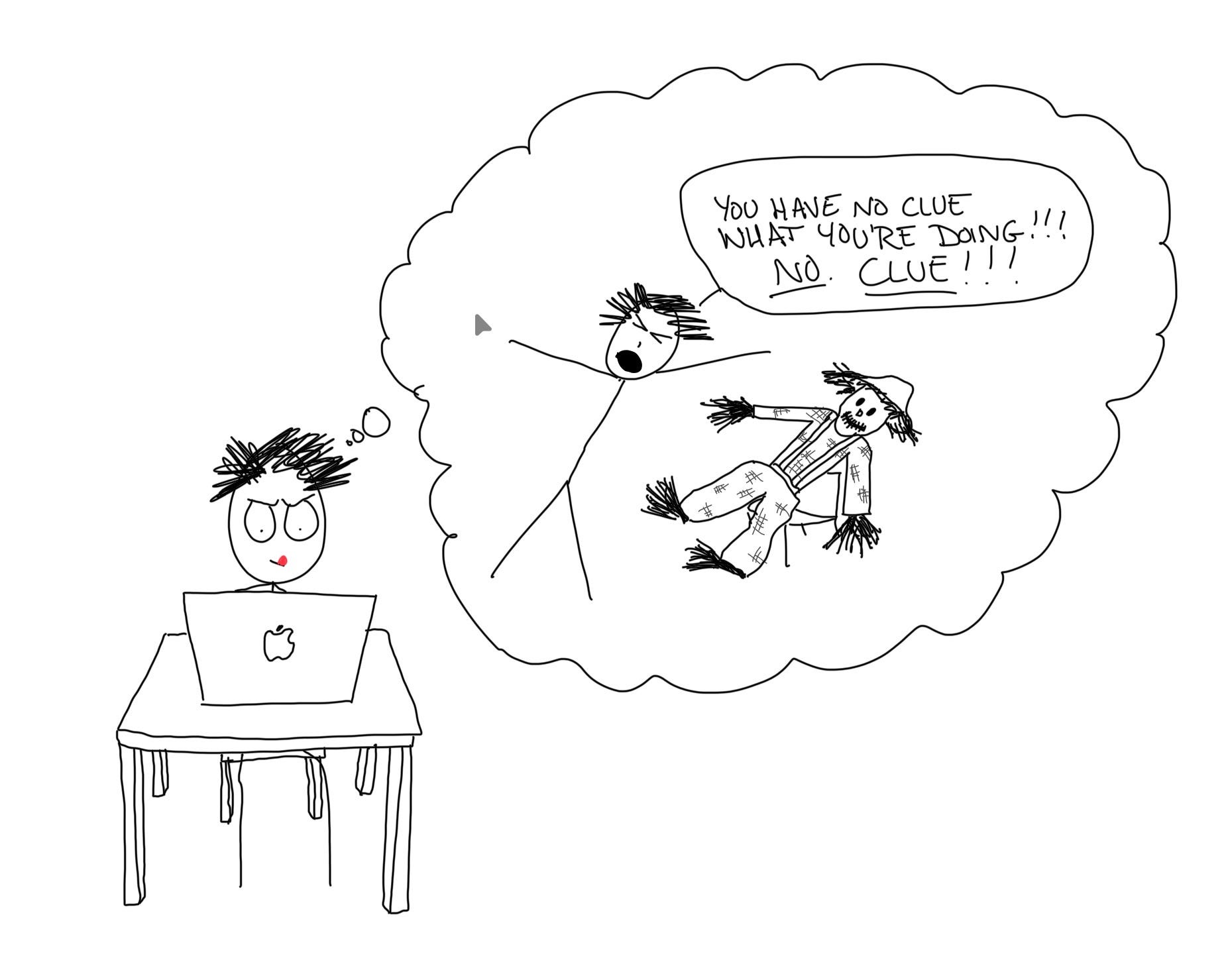
Bottom line: It was a fucking mess and I was soon left curled up on the floor in a puddle of my own tears.
Then I realized the reason I was struggling with this post and the reason these writers were struggling with their work was the same reason.
And it all came down to one thing: Constraint (or lack thereof).
In this Episode:
🎯 The Colin study – why writers who feel the most creatively free often produce the least creative work
📐 3 act structure in 3 minutes flat – what the vertical format’s forcing function strips away, and what it leaves behind
🔄 Everything old is new again – the broad comedy characters didn’t die, they migrated platforms
🎭 Dialogue, tone & the soapbox trap – why what’s left unsaid matters more than what’s said, especially in 3 minutes
🧊 The cold start problem – why your cast might matter more than your script when nobody’s watching yet
Creators Becoming Showrunners
Despite the ongoing consolidation in Hollywood, there’s reason to believe that power is shifting into the hands of more creators across the convergence economy:
Netflix recently announced ordering an independently-produced YouTube web series – American High’s Minimum Wage.
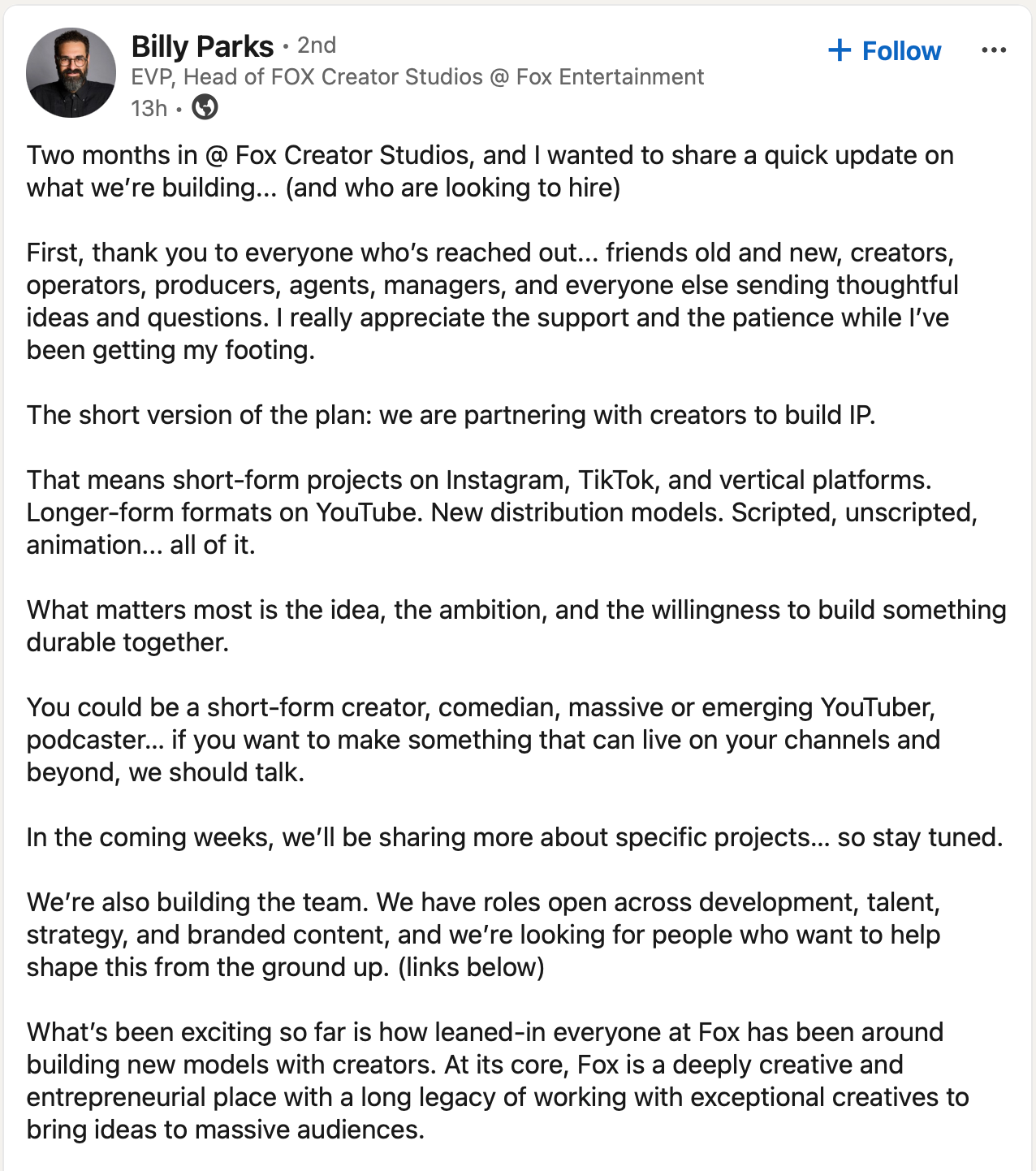
And just recently, on May 18th, Billy Parks – EVP of Fox Creator Studios – announced on his LinkedIn that the studio is doubling down on new new media, including but not limited to vertical content, and laid out their “mandate” publicly:
The trend extends to vertical content as well, from Netflix announcing their new “vertical feed” to Issa Rae returning to her UGC roots via collaboration with TikTok.
What’s now undeniable: The drumbeat of creators becoming Showrunners (or studios) on social media is accelerating.
And if that’s the case, the best proving ground for the Showrunners of the future is the vertical sitcom.
But beyond being just about opportunity, this proving ground has its own set of guidelines that creatives can learn from, whether they’re writing for cell phones or movie theater screens.
The Mirage of Creative Freedom
In 2022, a study was conducted that had two groups of participants draft a story. One group was told: “You can write anything you want” while the other was given a constraint: “The story must be about a shy, red-haired boy named Colin who is missing a toe.”
Then both sets of stories were read by independent evaluators, who deemed the stories about Colin to be more inventive than the unconstrained ones (even if the Colin writers found the exercise more challenging than the open-ended writers).
Basically, the stories produced without constraints ended up being more derivative of existing stories, and thus less creative.
What’s really interesting, though, is that the unconstrained writers felt more creative while writing their stories, even though that was not the actual case.
In essence, these unconstrained writers were conflating creative freedom with creativity, even though those two things seemed to be at odds with each other in practice.
The conclusion is inescapable:
Creative constraints tend to improve creativity rather than hinder it.
That said, you can’t just heap constraints onto the creative process and expect the benefits to unfold endlessly. The U-shaped curve below illustrates the optimal amount of constraint to produce more creative work.
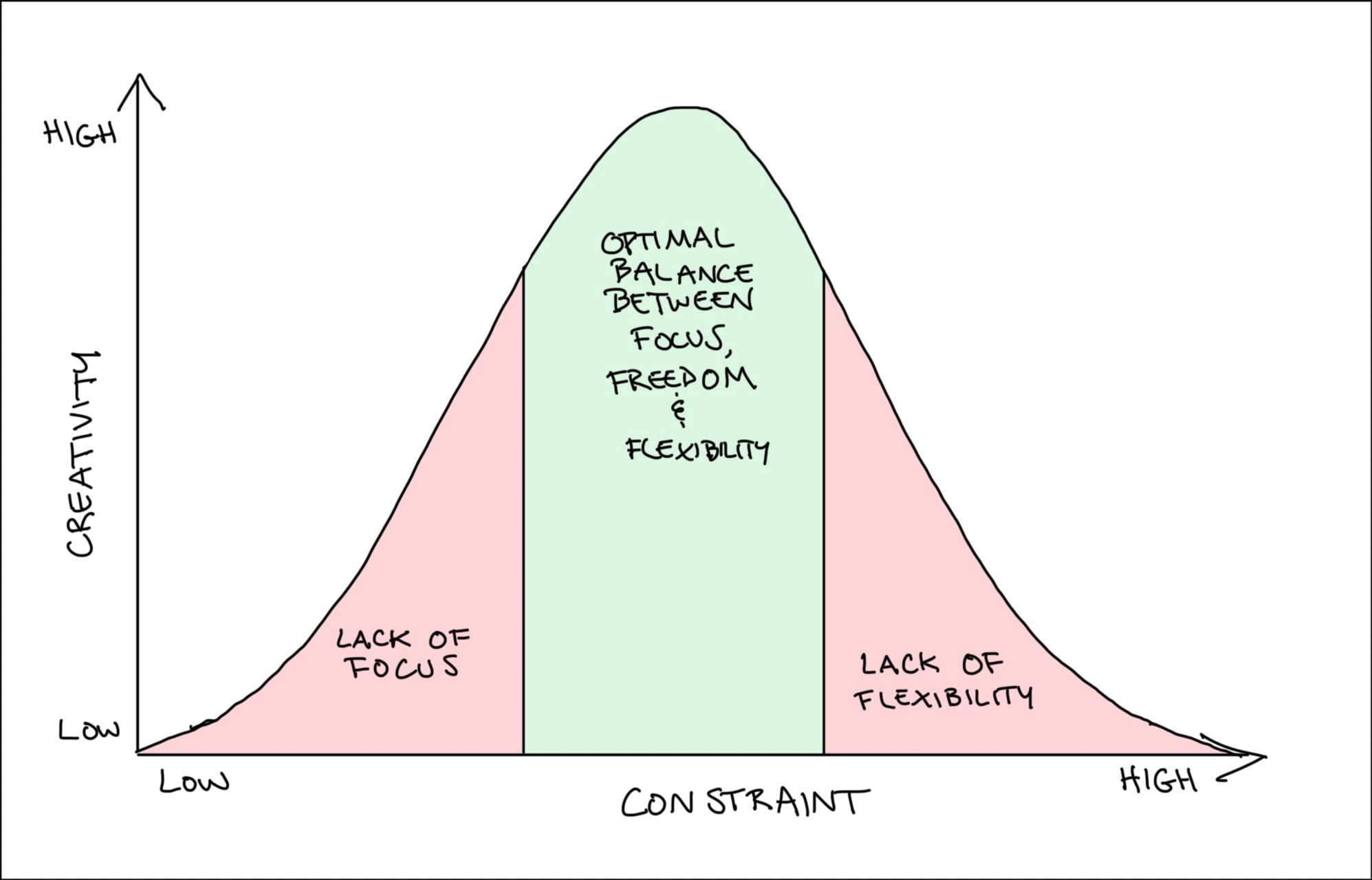
Leveraging self-imposed constraints1 improves creativity by focusing your work, but take it too far and you hit diminishing returns that end up stifling creativity.
Put another way:
Having too few constraints leads to unfocused work and having too many leads to insurmountable friction.
3 Act Structure in 3 Minutes Flat
Telling a story on Instagram is not like telling a story on a streaming platform like Hulu.
Apart from the obvious constraints like aspect ratio (landscape vs. vertical) and budget (high vs. low), there are countless factors at play that determine a social show’s success, from pacing and archetypal character development to development cycle length, repeatability and Time-to-Interest.
For those who have only ever worked in traditional media, it can be enough to make one’s head explode.
So let’s ease into it with something we’re all familiar with: Social video.
Let’s Get Reel
A Reel is Instagram’s name for a vertical video clips that get shared to both your social network and random strangers across Instagram.
While the length limit for a Reel is 20-minutes, reels longer than 3 minutes may not be recommended to new audiences, thus limiting exposure for longer videos. On TikTok, videos can be up to 60 minutes in length, but when recording through the app, the length limit is 10 minutes, if that tells you anything about their priorities when it comes to length.
The takeaway: If you’re looking for success in this format, there’s good reason to keep your videos shorter than 3 minutes.
Some people find this time limit too restrictive. It is a very short amount of time to tell a complete story, beginning-middle-end. I mean, how deep can your characters truly be if you only have 3 pages of script to work with?
But I strongly suggest reframing this constraint as a creative opportunity.
Think about what this page limit forces you to do.
It forces you to strip away all but the most fundamental and demonstrable aspects of your characters:
All the protagonist’s traits that don’t immediately impact their relationship with other characters? Gone.
All the backstory that you would have felt compelled to explain via exposition dump so you can “show your work?” Gone.
All the extraneous world-building and political intrigue and tertiary characters and flowery dialogue that no one was going to listen to anyway? Gone.
All that remains is how this character behaves in the here and now.
If your protagonist were a frequent flyer who wears all their clothes to get through security at the airport, then that means the constraints of social media are a TSA cavity search.
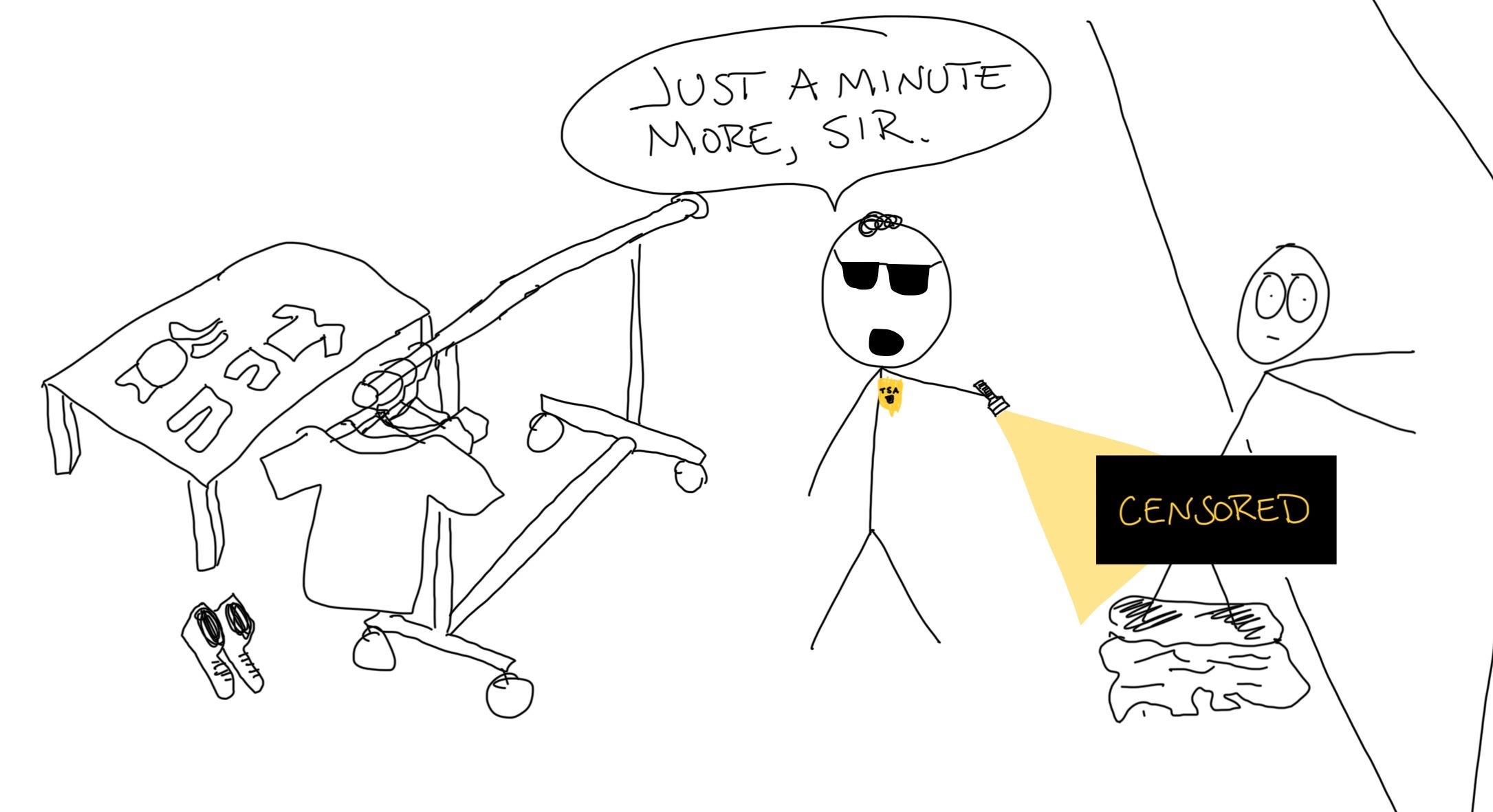
The 3-minute length constraint is what interaction designers call a forcing function, which is exactly what it sounds like: The constraint forces you to choose what about this story is most important to you.
It forces you to kill your darlings (and then some) and peel away distractions, until all you’re left with is the beating heart of character and goal and conflict and change.
It’s brutal, and it’s not for everyone.
If you’re used to writing 30-60 page pilots and you can’t imagine fitting an entire hero’s journey into a series of 3-page scripts, I don’t blame you for checking out now.
But I do think you (yes, you, professional writer person) would benefit from trying your hand at this format. It’s a really challenging exercise that reframes character development in a very useful way.
What’s Your Archetype
There’s something that I’ve discovered most all successful scripted social shows have in common:
A sharp, well-defined main character.
These characters stand out. They are not normal. They have strong opinions on very specific things, and they are all based on some form of character archetype.
Without going into another character deep-dive2, an archetype is a recognizable model or pattern that you can apply to the development of your own characters.
Ana Lasic does some good explorations of character archetypes in her Substack Intuitive Screenwriting, discussing such Jungian archetypes as The Sage, The Warrior, The Fool, etc…
And while these archetypes are the basis of all fictional characters, when writing comedy, I find it helpful to identify more specific sub-archetypes, ideally ones I can map to existing characters for easy reference.
This list is far from exhaustive. I’m aiming for illustration, not comprehensiveness.
The Confident Idiot
Gob Bluth from Arrested Development
Dennis from Always Sunny
Andy Dwyer from Parks & Rec
The Clueless Optimist
The Titular Kimmy Schmidt
Buddy from Elf
Maddie from Roomies
The Feral Wildcard
Rafi from The League (or basically any Jason Mantzoukas character)
Charlie from Always Sunny
Tracy Jordan from 30 Rock
The Nihilistic Youth
Aubrey Plaza’s character in Parks & Recreation
Thyme and Cale in Brooklyn Coffee Shop
The Socially-Unaware Coworker
Dwight from The Office
Kenneth from 30 Rock
Chit from The Chit Show
The Status-Climbing Try-Hard
Miranduh from The Broker.age
Tom Haverford from Parks & Rec
Tahani from The Good Place
If you study Jungian archetypes, you’ll notice that those first three sub-types are a version of The Fool, the next two are a version of The Outsider and the last one is a shadow of The Ruler.3
You’ll also probably notice that some of these characters belong to two or more groups (e.g. Kenneth could also be categorized as a Clueless Optimist).
That’s because all characters are some permutation of more than one archetype.
This is far from scientific, but if I were to quantify the archetypes of a handful of different characters from TV comedy (including some mentioned above), the maps would look something like this:
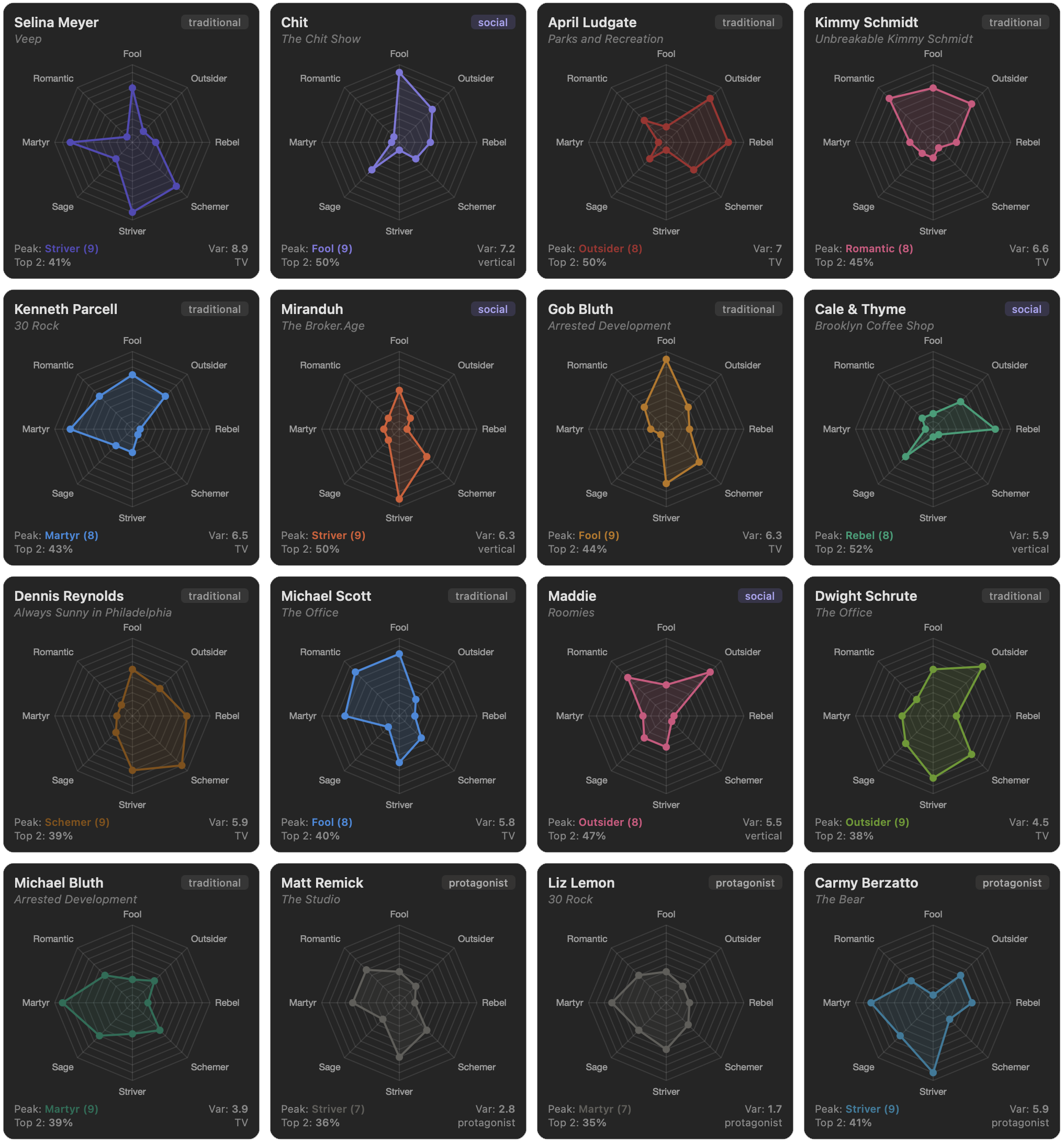
And when you examine these charts closely, you start to realize that the difference between characters on different formats isn’t merely aesthetic.
It’s structural.
Spikey Characters, Round Characters
One thing that you’ll notice pitting two radar charts against each other side-by-side:
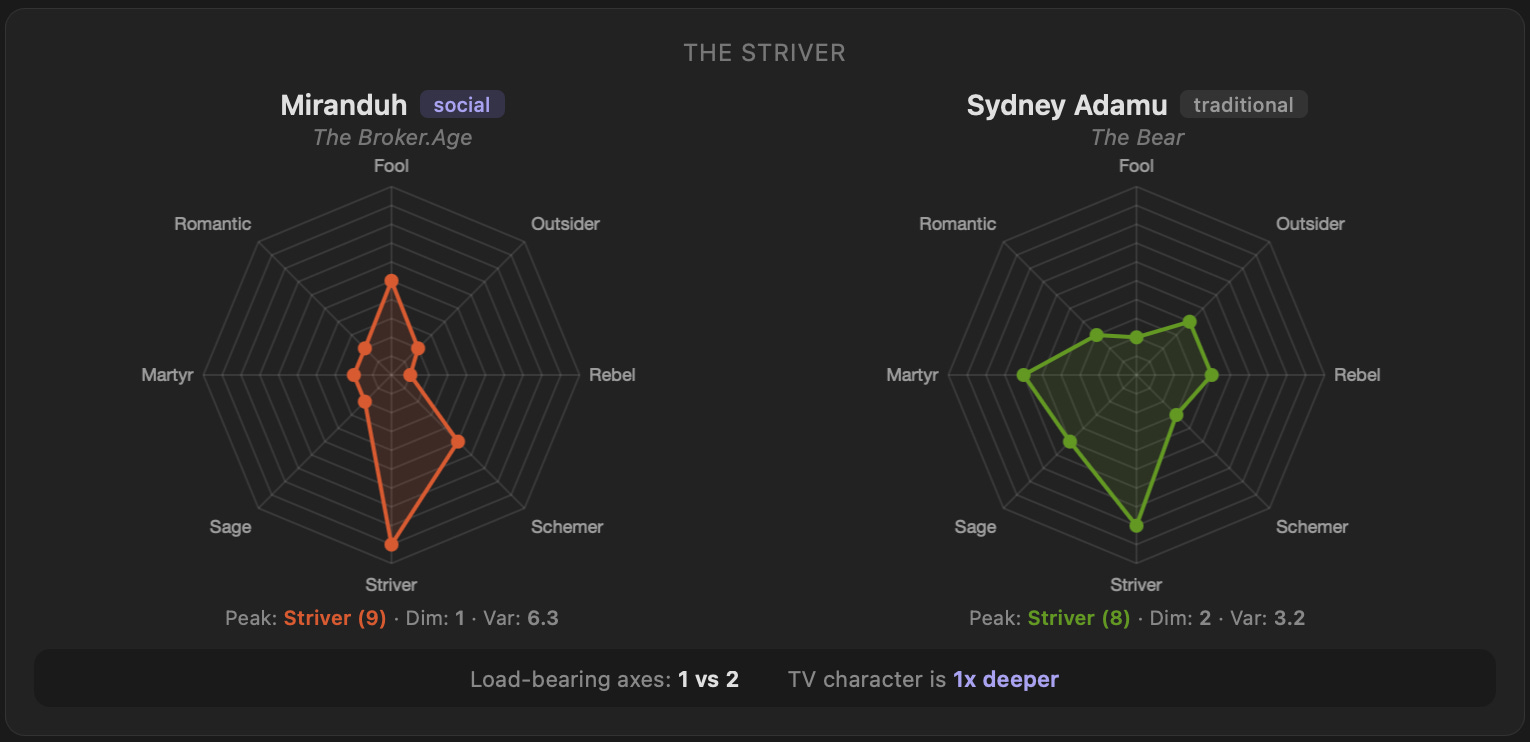
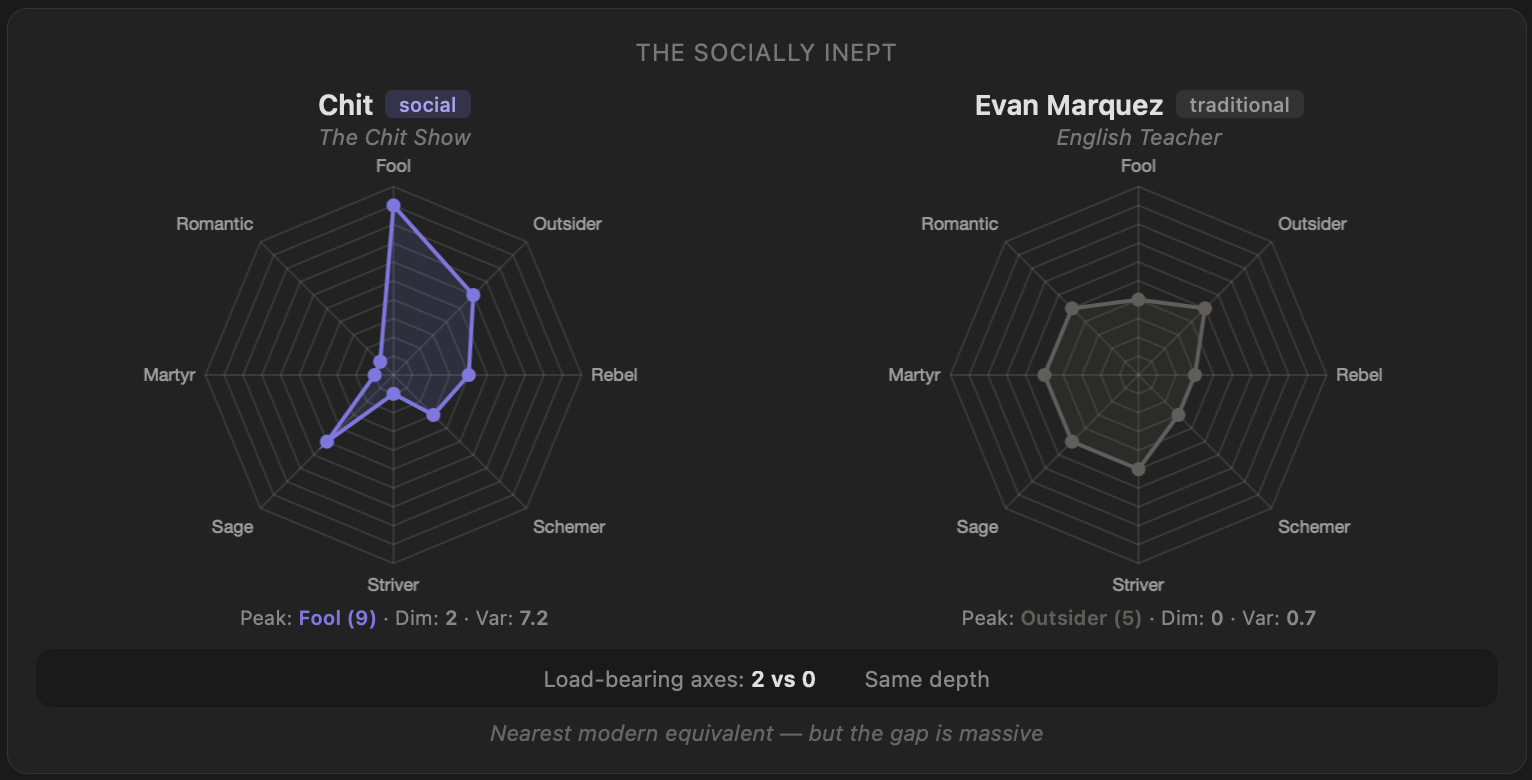
The social shows feature characters who are “spikier” than their traditional media counterparts. They are more heavily skewed towards one archetype than others where their modern corollaries are more balanced across different archetypes.
Side Note: There are the rare exceptions, like Liam Neeson’s character in The Naked Gun (a legacy property with old-school comedic sensibilities), but this remains the exception, as is evidenced by my struggle to come up with another example…
Mayhaps Stephen Follows can help quantify this trend with a more robust data-set (or invalidate whether such a trend exists)…?
In terms of character development, the spikiness of the graphs of social-first characters indicates these characters are more “one-dimensional” than their traditional media counterparts.
The archetypal variance of social characters are on average 1.7x higher than those of modern TV & Film characters.
That translates to characters who are less deep and less nuanced.
And that makes perfect sense. When you only have 3 minutes to tell a story, you don’t have time to demonstrate the nuances of deeply developed, multi-faceted characters.
The exercise made me realize that the vertical format is a forcing function that makes you choose: What about this character is most interesting / most exciting to you? What aspect of their personality do you want to focus on, backstory be damned?
But this charting exercise also led me to another – more startling (and more profound) – conclusion:
The traditional media (Film and TV) characters with the pointiest graphs were developed 20-25 years ago.
Everything Old Is New Again
As the first decade of the 21st century gave way to the second decade and then the third, broadly comedic characters on TV and Film have been disappearing, steadily replaced by protagonists who are more grounded, more “real.”
Whether that’s due to “authenticity” being the buzzword of the past decade is up for debate.
But no matter the cause, the Gob Bluths and Kramers and Charlie Kellys and Kimmy Schmidts and Dwight Schrutes of the world have been replaced by Matt Remick and Carmy Berzatto and Janine Teagues.
That much is obvious to anyone paying attention to scripted entertainment.
But there’s something less obvious that emerged from this archetypal evaluation:
Those broad, pointy characters didn’t simply vanish. They relocated to social.
Dwight Schrute and The Office may be no more, but Chit has taken TikTok and Instagram by storm
April Ludgate no longer shoots snarky barbs at her coworkers on Parks & Rec, but Pooja Tripathi can still deliver deadpan eye rolls every week on Brooklyn Coffee Shop
The Unbreakable Kimmy Schmidt’s wide-eyed optimism may only exist via the streaming back catalog, but we can still cheer on her 2020’s contemporary – Maddie – in Roomies
And it’s not like these archetypes appeared on social shows out of thin air. They had to. For whatever reason, TV abandoned them.
But the audience never did.
Based on the popularity of these social shows and the resurgence of decade-old sitcoms – there is a huge, undeniable appetite for big, funny, spikey characters.
And if you – like me – enjoy writing those types of characters, this moment represents a once-in-a-generation opportunity to capitalize on that fact.
So am I saying you should drop everything you’re working on and start developing your own version of The Chit Show?
Not necessarily.
But: If you’ve been considering a short-form vertical comedy series in the vein of Brooklyn Coffee Shop or Chit or Voila Brigitte… Now is the best time to get started.
Because – as I mentioned in a recent note – the wave is coming:
So how can you – dear reader – ride this wave?
Developing a Social Show of Your Own
So let’s say you’ve decided to take the plunge.
By now (hopefully) you understand that the foundation of a successful social show comes down to well-developed, well-defined characters.
But character isn’t the only determinant of success. There are other factors at play, which are innumerable.
For now, I’ll focus on the following:
Pacing
Dialogue
Tone
Casting
Pacing
“Start late. Leave early.”
–Screenwriting Advice 101
Professionals know that the best written scenes have already begun by the time the audience arrives. There’s an old piece of screenwriting advice that goes: “Start late, leave early.”
This philosophy bestows a few advantages:
Giving the audience too much context / background puts them ahead of the story – in a bad way. If the audience knows too much, you run the risk of disengaging their curiosity.
It forces the writer to focus on what the point of the scene actually is. You can spend a bunch of time exchanging dialogue and grinding out exposition and learning about a character, but a scene’s sole purpose is (or should be) to move the story forward, and any part of the scene that doesn’t do that has to go.
Overly-long scenes are boring. They’re boring to write. They’re boring to read. They’re boring to watch. This is one of those situations where less is truly more.
In other words:
Don’t start at the very beginning. It’s a very bad place to start.
This is true for TV and film, but it is even truer for social-first series.
Now, if you’re a good student who has done the research, you may be saying:
“Wait a minute. What about Brooklyn Coffee Shop? Don’t they start every episode with a new person entering the scene? Isn’t that them starting at the beginning?”
Yes: Mechanically, literally, each episode starts at the beginning of the guest star’s interaction with Cale and Thyme, when the guest star enters the doors of the eponymous coffee shop.
But functionally, the show still adheres to the “Start late, leave early” premise, because – every time someone new enters – Cale and Thyme already have a pre-established attitude about the character.
They either know the character personally, or they know the type. See:
In every episode, the baristas and the guest stars have history together (whether the guest star knows it or not).
In other words:
While the characters enter the interaction at the very beginning of the episode, their opinions / attitudes were formed well before the start of the scene.
This demonstrates something crucial:
Well-defined characters with strong points of view are not only more interesting to watch. They also expedite pacing, which is crucial when you only have 3 minutes to tell a story.
This is one of the big benefits of a spikey character chart.
Dialogue
The (cheap) cost of these social series means that the creators have to deliver the story largely via dialogue and interpersonal conflict (and mockumentary testimonials, an old standby).
Writers intuitively know the power of well-written dialogue to demonstrate character. And they’re more than happy to do so after having spent so much time developing those characters.
But dialogue is also one of the first spokes to break in the wheel of character.
What I mean by that:
Writers know that the things a character says define that character. But – in my experience, reading many, many scripts from emerging writers – they also often miss something even more crucial:
What a character says is often less important than how those things are said and what’s left unsaid.
As I alluded to at the top, there’s no better way to disengage an audience than with bald dialogue that explains who the character is (a practice I call “backstory dumping”) and/or how they feel about a particular topic (a practice I call “soapboxing.”)
And while that stuff can be a turn-off in traditional media, it is downright poison in social series.
And now I hear you saying:
“Wait a minute. Don’t the baristas in Brooklyn Coffee Shop soapbox all the time? Why should they get a pass??
First off: Calmez-vous.
Second, Thyme and Cale have strong opinions about the state of the world / capitalism / feminism / modern society / etc., but the comedy (and story) of BCS comes not from the things they say but how they say it (usually deadpan, with an accompanying eye roll).
In other words: The rant is not the point. The point – and the comedy – comes down to one thing: Attitude.
They are performing counter-cultural liberal elitism, all packaged in an easy-to-digest sarcastic Gen Z package. They are just as much the butt of the joke as are the guest stars, who are stand-ins for different persona types.
You can tell that the people writing and playing these parts don’t take themselves too seriously.
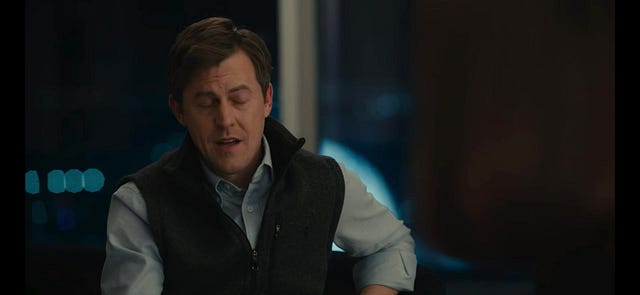
Compare this to, say, a show like Hacks – where the show’s creators / star wear their political posturing on their sleeves. See:
 Tiktok failed to load.
Enable 3rd party cookies or use another browser
Look: I get it. Sometimes the only weapon creatives have against the relentless onslaught of the broligarchy is the written word.
But this is the dictionary definition of soapboxing, and if it happened on a social show, it would die a fast death. Not because people don’t agree with it, but because this sort of baldly-delivered political stance is EVERYWHERE on social media.
It doesn’t offer audiences anything they aren’t already getting in their social feed.
There is no room in a 3-minute episode for a lengthy political rants, and even if there were, your show is not where audiences would go to get their fix of political rants.
The lesson for social shows: Ditch the diatribe.
Tone
The most successful shows in this format are weird.
Characters get robbed by a jaunty guy in a Spider-Man costume (in the pilot)
Experimental theater directors produce shows with insanely inappropriate names
Bottom line: The characters are weird. They say weird things in a weird way. They make weird decisions and set weird rules in a weird world where weird things happen.
I believe this is a function of needing to stand out.
In the crowded world of social media, you need to stand apart from your neighbor. One way to do that is to lean into whatever is unique about the story and resist the urge to ground it in realism.
The landscape may change, but as of the time of this writing, the world of social media punishes small, grounded, personal fiction stories, and the reason is clear:
These types of stories – the small, grounded ones – already exist on social media in massive quantities. Furthermore, they are told by real people sharing their actual lives.
These are deeply personal stories about break-ups and family drama and workplace micro-aggressions… In other words:
Why watch the fictionalized version when you can see the real thing in all its authentic glory?
Okay, so… What about The Ick?
Well, I think it’s the exception that proves the rule. People love mirrors, they love watching themselves (and by extension, people they know), and nowhere is that more evident than with a model like The Ick’s.
If you’re not familiar with it, The Ick is a relatively grounded vertical series about real-life stories submitted by fans, all around the theme of “the ick:” That moment where someone witnesses something in their romantic partner that suddenly turns them off to the whole relationship.
The catch: These are all real stories submitted by real people who encountered their very own ick in real life. People write in from all over the world, and then The Ick creators dramatize these real-life stories on their channel with 600k+ followers.
You literally can’t make this shit up (or at least, you don’t need to).
I think we can attribute the success of these grounded stories to the realism behind them. Real stories submitted by real people who actually experienced them. Also: The interactive component doesn’t hurt.
But for all non-semi-autobiographical stories, the lesson remains:
Write about characters you know, but when it comes to tone, go big or go home.
Casting
As far as I’m concerned, in all things scripted entertainment, the two most important things are:
Writing
Casting
I’ve discussed this at length in the past, but there’s no amount of production value that will make up for bad writing or bad casting in features, shorts and TV series.
A social series is no different.
Just as a poorly written social show will fail the sniff test of audiences online, a poorly cast show will collapse under the weight of its bad performances.
I won’t go into what constitutes “good performance” here. Follow Anna LaMadrid if you want some insights into that realm.
But beyond believability and quality of performance, there’s another thing to consider, which I call:
The Cold Start Problem
For reasons I won’t go into here, I recommend giving each social show you create (because you’re going to create more than just one, right???) its own channel on social. So Upstage gets its own channel and Casen Pointe gets its own channel and our other show releasing later this month also gets its own channel.
The cold start problem emerges when you’re getting started with 0 followers (which all new show accounts will have).
If you’re not distributing to a large audience, you’re not giving your truest fans a chance to find you. You’re largely beholden to the luck of the algorithm, which distributes your video randomly to an audience of ~50 people, then (if engagement is high enough) ~150 people, then ~1,000, and so on.
But 50 people is a tiny, probably unrepresentative, sample size, and if those people don’t vibe with your sense of humor or story or character or whatever… that’s a bad draw that can tank an otherwise winning combination of factors.
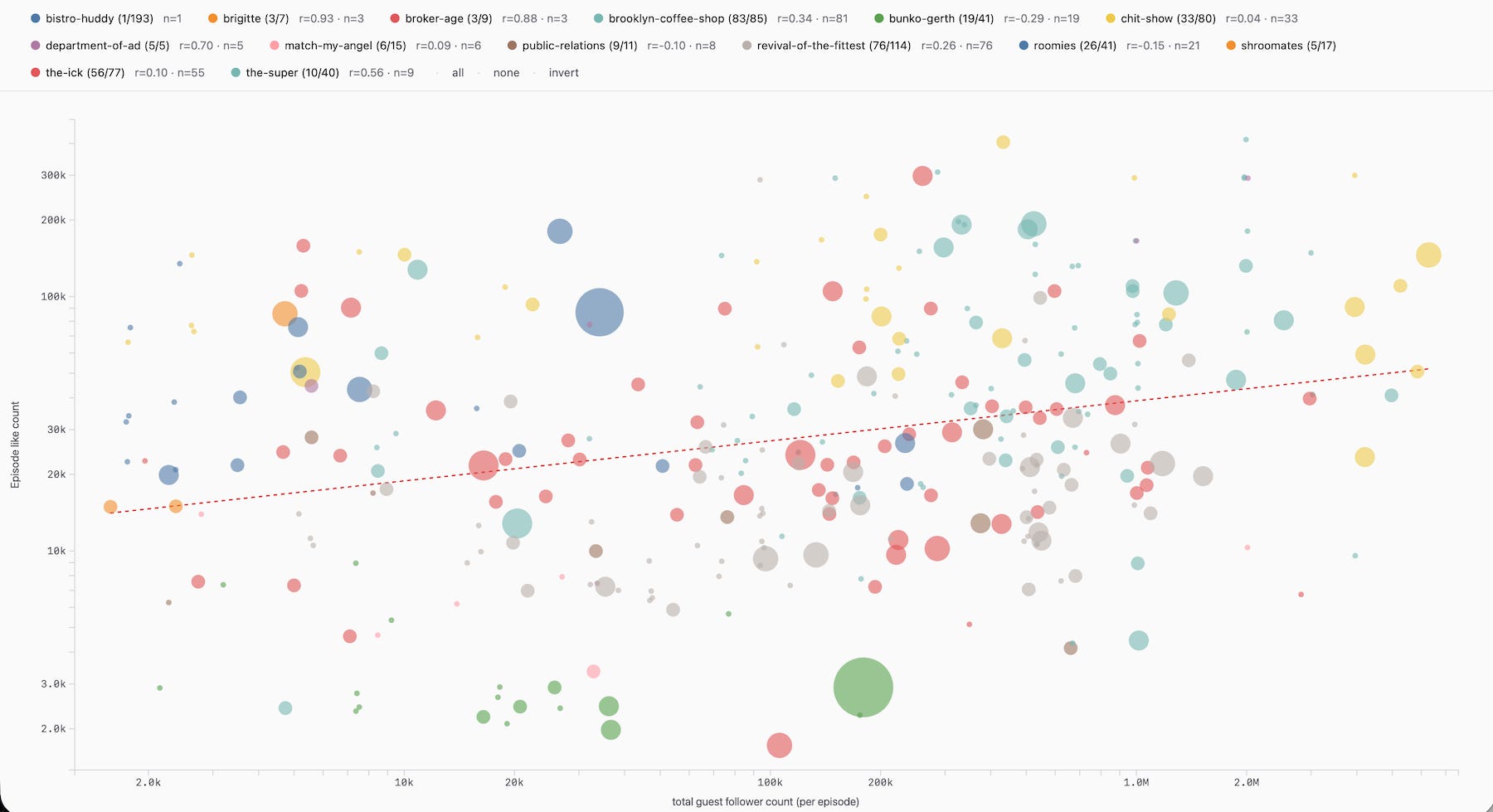
Whereas, if you – or a cast member who’s willing to co-author a post – have a large following, the early episodes of the series get served to a larger audience, you jumpstart your audience size via a larger initial sample, and you give your fans a better opportunity to find you.
Then you can focus on craft instead of hoping for a lucky draw.
This isn’t speculation, by the way. Like Chit, I, too, crunch the numbers. I’ve been collecting tens of thousands of data points over the past couple months and there is a clear positive correlation between guest star follower count and success metrics like engagement and raw view count.
What This All Means
I’ll be first to admit: The constraints of social media can often feel stifling.
Is 3 minutes enough time to tell the deeply personal, thoroughly grounded reflection piece you’ve been wanting to make for the past 15 years?
Probably not.
Does it force you to remove nuance and depth from your characters?
Yeah, a bit.
Does it suck to have to abide by these arbitrary rules that are shaped by a faceless, uncaring algorithm?
Kinda.
But I encourage you to reframe these constraints in a positive light.
Because these rules that they impose – about pacing and exposition and soapboxing and characters defined by behavior instead of bio – those rules are just as applicable to Film and TV. They are rules that every format should follow.
Social just makes it impossible to cheat.
And if you still doubt the power of constraints, I’d love to show you the alternate post to this one. The one where I spiraled into a shouting match with an imaginary writer about all the things they were doing wrong. The fucking mess.
That draft was 4,000 words of backstory and soapboxing.
So I buckled down, applied some constraints, got rid of the backstory, and wrote this instead.
I hope that was the right decision.
Stay tuned,
Jon
A different study showed that self-imposed constraints were better for creativity than externally-imposed constraints.
While I intuitively knew that these groupings did not cleanly map to individual Jungian archetypes, I’m not smart enough to have identified the specific groupings, so I used AI to do that.
Speaking of 3-min films: www.strangers.now
(not fiction, not vertical, but on Substack!)
Jon - again, a really passionate and incredibly useful post on a problem all writers are facing right now. I’m teaching a class at the Barcelona school of design (unfortunately, online, no trip to Barcelona) and my first class to the writers is about tailoring their work and their expectations to this new reality. Even If they think their work will be bought by a studio or streamer, that traditional company is STILL going to have to reach an audience through social media… so start where the audience is. Great post.